Social Media Addiction: The Dangers of Social Media
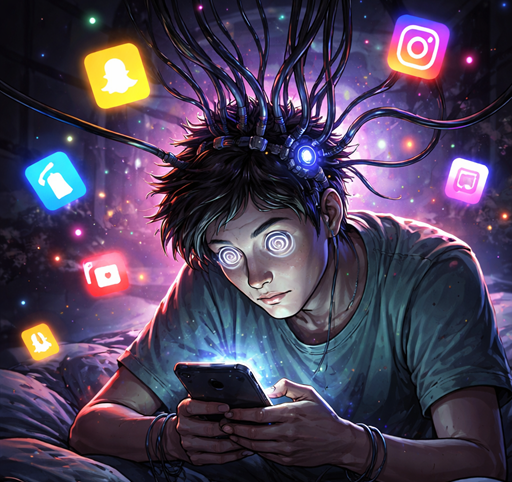
It’s probably happened to you: you open Instagram or TikTok for “just five minutes” and before you know it, thirty minutes have passed, leaving you feeling tired, empty, and unmotivated. In 2024, the term ‘brain rot’ was named word of the year by Oxford University Press to describe the mental effects of this excessive phone use. But what truly lies behind this endless scrolling? It’s not a lack of discipline; it’s the result of a multibillion-dollar industry designed to hijack your brain.
The Psychology of the Slot Machine
Big Tech companies like Meta, TikTok, and X operate within the so-called attention economy. In this model, you are not the customer, but the product. Your attention is harvested and resold to advertisers. To maximize these profits, platforms use sophisticated psychological techniques that directly affect our dopamine system.
One of the most powerful tools is the variable reward schedule, similar to how a slot machine works. When you refresh your feed (the ‘pull-to-refresh’ motion), you are essentially pulling the lever of a digital slot machine. You never know if the next post will be a ’like’, a funny video, or a shocking news report. This unpredictability ensures a maximum release of dopamine in the brain, leading to compulsive checking behavior. Features like ‘infinite scroll’ also eliminate natural stopping points, causing you to keep watching without your brain getting a moment to reflect.
The Toll on Mental Health
The constant overstimulation of the dopamine system is not without consequences. Experts warn of a ‘reward deficiency syndrome’, where the brain becomes less sensitive to dopamine. As a result, everyday, natural rewards, such as a walk or a conversation, can start to feel boring and uninteresting.
Especially in young people, whose brains are still fully developing, the risks are significant. The prefrontal cortex, responsible for executive functions like concentration, decision-making, and impulse control, can be affected by the constant switching between short, fast stimuli. Research directly links problematic social media use to increased feelings of anxiety, depression, and loneliness. The pressure to always be connected and constant social comparison erode self-esteem and cause sleep problems.
A Threat to Autonomy and Democracy
The power of these platforms goes beyond individual well-being. A handful of engineers in Silicon Valley have unprecedented influence over the thoughts and choices of billions of people. Algorithms are not neutral; they are programmed to maximize engagement, which in practice often means that emotionally charged, polarizing, or even false content rises to the top.
This creates ‘filter bubbles’ where users only see information that confirms their own worldview. Critics like Shoshana Zuboff speak of surveillance capitalism: a system where our most private data is used to predict and steer our behavior. When economic power on this scale merges with political influence, democracy itself is at stake. We see that platforms can undermine the sovereignty of states and disrupt public debate by determining which voices are heard and which are silenced.
The Geopolitical Context: Privacy Under Pressure
The dependence on American platforms also brings specific privacy risks. In the United States, there is no comprehensive national privacy law like the European GDPR. American surveillance laws allow government agencies like the NSA to request data from tech companies. With the return of Donald Trump to power and his alignment with tech billionaires like Elon Musk, fears are growing of further erosion of personal data protection and the dismantling of European digital rules.
Entering the Lion’s Den: Strategic Use of Big Tech
While we strive for full digital autonomy, current reality forces us to sometimes “enter the lion’s den.” Due to massive network effects and the dominant market position of American tech giants, users are currently found in large numbers on these platforms, making it nearly impossible for new European alternatives to build an audience from scratch. Just as newsrooms depend on social media to attract readers, we must strategically use platforms like Reddit or Instagram as a signboard to make people aware of big tech’s dominance and entice them to switch to safer European alternatives.
The Power of European Alternatives
There is a growing ecosystem of European technology companies and decentralized networks that have privacy and digital sovereignty as core values. Instead of maximizing profit through behavioral manipulation, these alternatives stand for transparency and user control.
One of the most promising alternatives to traditional social media is Mastodon. This is a decentralized platform that is not run by a single company for profit, but by a network of independent servers. Mastodon has no algorithms trying to make you addicted and is free of advertisements.
Time for Digital Autonomy
The battle for our attention and data is an asymmetric war where we as consumers often get the short end of the stick. It is essential to realize that your timeline is not an objective representation of reality, but a product of a business model.
At PixelUnion, we believe that privacy and security are not options, but fundamental rights. While American platforms analyze your photos and behavior to train algorithms, we offer a safe European alternative. Our servers run on European soil, fully in line with the strict European privacy values.
Reducing our dependence on American ‘big tech’ is the only way to true digital autonomy. By consciously choosing transparent, European alternatives, we take back control over our data and our attention.