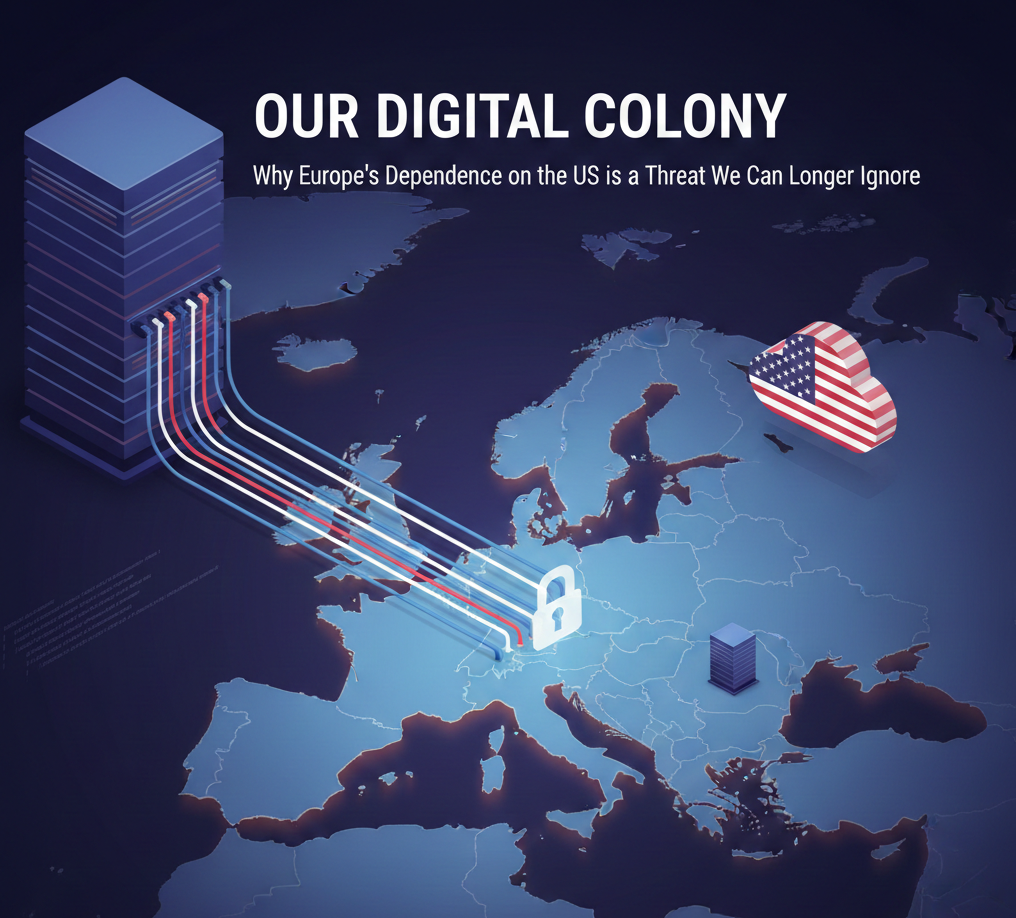
Our Digital Colony: Why Europe's Dependence on the US is a Threat We Can No Longer Ignore
The Cracks in Our Digital Foundation
In an era defined by digital transformation, the infrastructure that underpins our governments, economies, and daily lives has become a matter of strategic survival. Yet, across Europe, we have built our modern society upon a digital foundation that is not our own.
At a time when the transatlantic alliance shows signs of unprecedented strain, Europe’s near-total reliance on American technology has evolved from a commercial convenience into a critical and unacknowledged vulnerability. This is not hyperbole. When a sitting US president openly threatens a NATO ally over territory and uses economic statecraft to sanction an international court on European soil, the theoretical has become tangible.
We are, as tech expert Bert Hubert has argued, experiencing a profound crisis of digital autonomy. Our dependence is now “nearly total,” and worries about our “former ally are no longer theoretical.” This is not an abstract risk; it is a clear and present danger to our sovereignty. We must ask ourselves a fundamental question:
What happens when a foreign power, for reasons of its own political expediency, can simply “lock us out of our own mailboxes”?
The Illusion of the Cloud: Unmasking Our Vassalage to US Big Tech
For most, “the cloud” is an abstract concept-a convenient, ethereal space where data lives. This illusion is strategically dangerous. The cloud is not an abstract entity; it is a physical infrastructure of servers, cables, and data centers, an infrastructure overwhelmingly owned and operated by a handful of American corporations.
This concentration of power has created a state of digital vassalage for Europe. According to a briefing by the European Parliament, the global market is dominated by a few giants:
| Provider | Market Share |
|---|---|
| Amazon | 29% |
| Microsoft | 20% |
| 13% | |
| Alibaba | 4% |
This reality has fostered a mindset of learned helplessness. While the director of the Centre for Cybersecurity Belgium (CCB) claimed it is “impossible” to store data fully in Europe, Bert Hubert sharply counters that his own employees could achieve this task after a single visit to a local computer store. Our problem is not a lack of capability, but a failure of imagination and political will.
The Threat Made Real: When Political Disagreements Become Digital Lockouts
The danger of our reliance on US technology is not a future hypothetical; it is a present reality through two primary strategies:
Political Coercion
The reliability of the United States as a stable partner has been thrown into serious doubt. Consider the aggressive posture taken towards Denmark over Greenland, where rhetoric revealed a willingness to treat long-standing allies as adversaries to be coerced rather than partners to be consulted.
Legal and Digital Coercion
This is evidenced most starkly by the case of the International Criminal Court (ICC) in The Hague. The White House used the International Emergency Economic Powers Act (IEEPA) to mandate the blocking of:
“All property and interests in property that are in the United States… or that are or hereafter come within the possession or control of any United States person.”
Because “United States person” includes entities like Microsoft, Amazon, and Google, the ICC was literally locked out of its own mailboxes. We saw this again with the Amsterdam Trade Bank; Microsoft refused to provide court-appointed liquidators with a copy of the bank’s own data, citing US sanctions law.
Continent Knowingly at Risk: The Price of Inaction
Despite these warnings, European institutions continue to deepen their dependence. The Dutch government recently moved all tax agency documents to the Microsoft cloud, while openly admitting that “our tax operations will now become vulnerable to sanctions.”
This vulnerability is codified in the US CLOUD Act, which grants American law enforcement extra-territorial powers to access data. In July, Microsoft confirmed to the French senate that European data on Microsoft servers-even those physically located in Europe-can be accessed by US agencies.
European leaders remain trapped in a self-fulfilling prophecy:
- They are “indoctrinated” that only US clouds are viable.
- They demand “perfect parity” before switching to European alternatives.
- The Result: No European competitor can reach the scale needed to grow because they are denied a customer base.
Reclaiming Our Future: The Path to European Digital Sovereignty
Digital Sovereignty is defined by the European Parliament as “Europe’s ability to act independently in the digital world.” European Commission President Ursula von der Leyen has identified achieving “technological sovereignty” as a key goal, but policy papers are not enough.
Achieving sovereignty requires:
- A Shift in Mindset: Moving away from the “American experience” as the only valid model.
- Re-engagement: Large-scale operators (governments and banks) must utilize the generic IT capabilities that already exist in Europe.
- Procurement Reform: Choosing European infrastructure to build the scale necessary for a resilient future.
Your Role in Building a Sovereign Europe
The challenge of digital colonialism can feel immense, but the solution begins with conscious choices. While governments deliberate, the power to build a more resilient digital Europe rests in our hands.
At PixelUnion, we are actively participating in the solution. We are building independent, European-owned and operated infrastructure to give you a real alternative to Big Tech. By moving your data to European providers, you contribute to a more resilient, independent, and sovereign digital future.
Take Your First Step Toward Independence
Join us in building a sovereign digital ecosystem. Use the coupon code below to secure your data on European soil:
- Coupon Code:
NEWYEAR2026 - Offer: 50% off your first year of media storage at PixelUnion.