The US CLOUD Act Explained: What It Means for Your Photos and Privacy
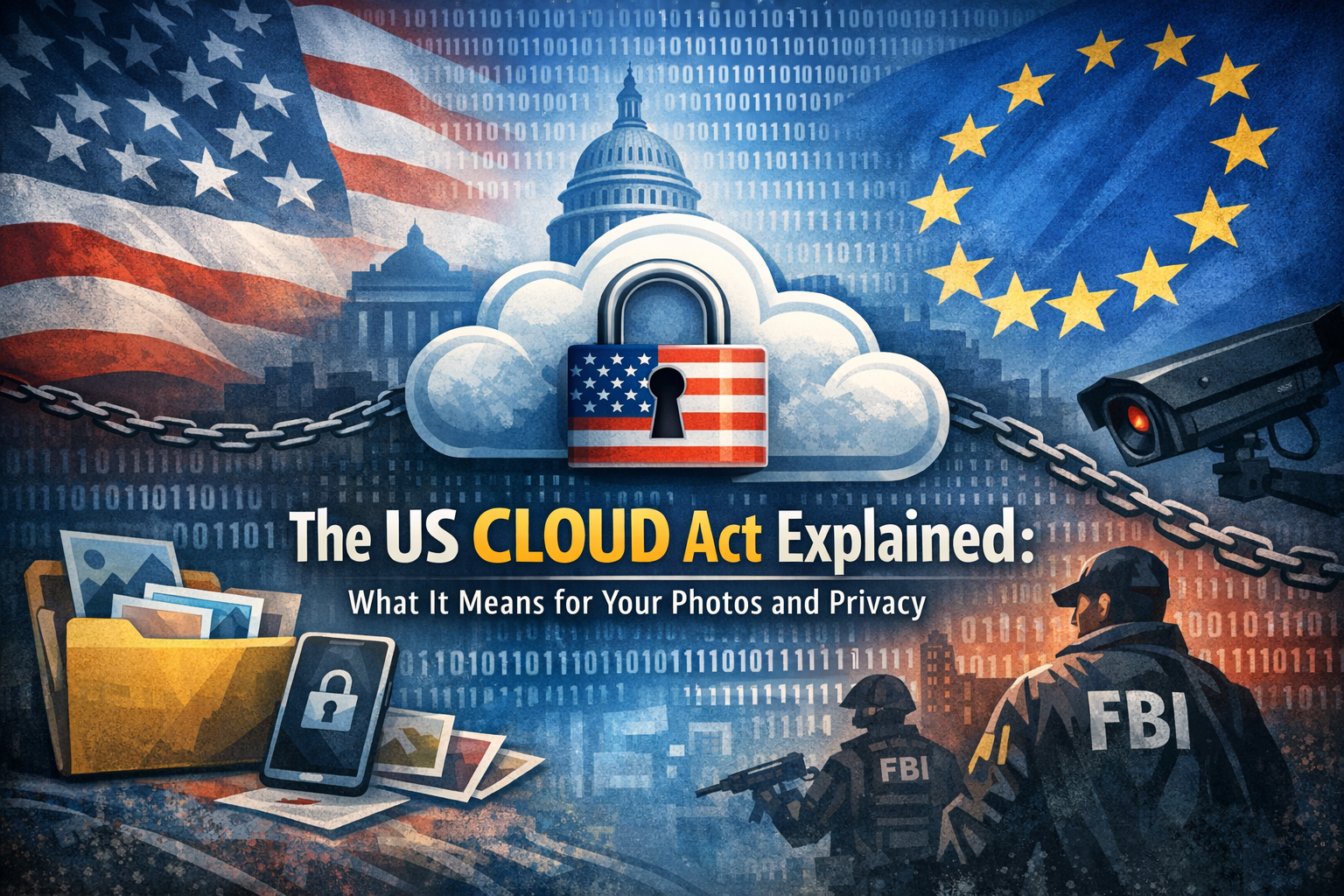
Your photos are in “the cloud.” But whose cloud? And whose laws apply?
If you’re storing pictures on Google Photos, iCloud, OneDrive, or Dropbox, you probably assume your data is protected by the privacy laws where those servers live. If your photos are stored in Europe, you might think European privacy rules - like GDPR - keep you safe. But there’s a US law you’ve probably never heard of that can override all of that. It’s called the CLOUD Act, and it matters more than you think.
What Is the CLOUD Act?
The CLOUD Act is a short, dense piece of US law from 2018. The name stands for “Clarifying Lawful Overseas Use of Data” - which honestly sounds more confusing than the law itself. You can read the actual text here, but we’ll translate it into plain English.
Here’s the core idea: If a US company stores your data - even if those servers are physically in Europe - US law enforcement can demand that company hand over your data directly, without asking permission from European authorities first.
Think of it like this: You rent an apartment in Paris. The landlord is American. Under normal rules, if the police want to search your apartment, they’d have to go through French courts and get French approval. But what if there’s a rule saying American landlords have to open their doors to American police anytime they ask? That’s essentially what the CLOUD Act does - it lets US law enforcement bypass European legal processes and go straight to the company storing your data.
The CLOUD Act allows US authorities to demand data from US tech companies, even when that data is stored on European servers and belongs to European citizens - potentially overriding European privacy protections.
Why This Matters (Even If Your Data Is in Europe)
You might think: “My photos are stored in a German data center, protected by German law.” That sounds safe. But it’s not the law protecting the building that matters - it’s the law protecting the company running the building.
When you upload photos to Google Photos, Google (a US company) is responsible for them. Google’s headquarters is in California. Google must follow US laws. If US law enforcement shows up with a legal demand, Google has to comply with US law - even if your photos sit in servers in Frankfurt, Amsterdam, or Dublin.
The CLOUD Act was actually designed to solve a different problem: it was meant to help US tech companies avoid conflicting legal demands from multiple countries. But the side effect is that it created a legal pathway for US authorities to access data stored anywhere in the world, as long as a US company is holding it.
GDPR Doesn’t Protect You from the CLOUD Act
Here’s where it gets important: GDPR (the EU’s General Data Protection Regulation) is fantastic. It gives you rights, it limits what companies can do with your data, and it forces transparency. But GDPR is about what companies can do with your data on their own. It’s not a shield against government requests.
The CLOUD Act is about government access. GDPR can’t stop US law enforcement from making a legal demand under CLOUD Act rules. They’re two different things:
- GDPR controls what companies do with your data in normal, everyday business
- CLOUD Act controls what governments can demand from those companies
Even a company that follows GDPR perfectly still has to comply with a CLOUD Act request from US authorities. It’s like having the world’s strictest landlord rules - but the police can still get in if they have a warrant.
Who Is Actually Affected?
Basically: anyone using major cloud storage or photo services. This includes:
- Google Photos and Google Drive
- Apple iCloud
- Microsoft OneDrive and Outlook
- Dropbox
- Amazon Photos
- Facebook and Instagram (which also host your photos)
- Any other US-based cloud company
If a US company stores your data, the CLOUD Act could apply. This isn’t theoretical - US law enforcement has already used CLOUD Act authorities to request data from tech companies, and companies generally comply.
Real-World Consequences
Let’s make this concrete. Imagine:
A journalist in Poland uses Google Drive to store research and documents. US authorities investigating the journalist’s sources could demand Google hand over everything - even though the data is stored in Europe and the journalist is European.
A photographer in Germany uses Dropbox to back up client photos and contracts. If under investigation for some reason, US authorities could access those files without going through German courts.
An activist in Hungary uses Gmail and Google Photos. US authorities could access their emails and photos if they had a legal basis to do so.
These aren’t paranoid scenarios. This is how the law actually works.
How the CLOUD Act Differs From Other Rules
You might hear about laws like GDPR, SCHREMS II, or data adequacy decisions. These are important, but they work differently:
- GDPR tells companies how to handle your data. It doesn’t stop governments.
- Data adequacy decisions (like between the EU and US) try to create trust between regions. But they don’t override CLOUD Act.
- SCHREMS II made it harder to move data between continents. But it doesn’t prevent CLOUD Act requests once data is with a US company.
The CLOUD Act sits above most of these - it’s a direct legal pathway for US authorities to access data.
What Can You Actually Do?
You can’t opt out of the CLOUD Act. But you do have choices:
1. Use European-based alternatives. Services like Nextcloud, Proton (based in Switzerland), or smaller European providers aren’t subject to CLOUD Act because they’re not US companies. This gives you real protection under European law.
2. Encrypt before uploading. If your data is encrypted end-to-end (you hold the keys, the company doesn’t), companies can’t hand over readable data even if authorities demand it. Look for services with zero-knowledge architecture.
3. Understand the risk. For casual family photos? Maybe the risk is acceptable. For sensitive documents, medical records, or anything you need to keep private? It’s worth considering alternatives.
4. Support privacy legislation. Advocate for stronger European data protection laws and regulations that limit how US authorities can access EU citizens’ data.
Why PixelUnion Exists
We built PixelUnion precisely because of concerns like this. PixelUnion is a European, privacy-first managed photo and video storage service. Your data stays in Europe, under European legal protections. We don’t sell your data, we don’t build profiles on you, and we’re not subject to the CLOUD Act because we’re not a US company.
We believe you should be able to store your photos and memories without wondering if a foreign government can access them without your knowledge or consent.
The CLOUD Act isn’t a secret conspiracy. It’s a real law with real consequences. You don’t need to panic, but you do need to understand it - especially if you care about your privacy. Your photos tell your story. You deserve to know whose rules protect that story.
Discover privacy-first photo storage without the CLOUD Act concerns. Learn more about PixelUnion.