2025: The year Europe woke up
2025: The year Europe woke up
For years, we told ourselves the internet belonged to everyone. We clicked ‘Accept’ without thinking, stored our most precious memories in the cloud of American giants, and ignored the warnings. “I’ve got nothing to hide,” was the excuse. But in 2025, the uncomfortable truth can no longer be ignored: when it really matters, here in Europe we handed over the keys to our digital home a long time ago.
This year showed-painfully-what experts had been predicting: our digital dependency is no longer a theoretical risk, but an acute threat to our freedom and privacy.
The ‘Kill Switch’ prophecy becomes reality
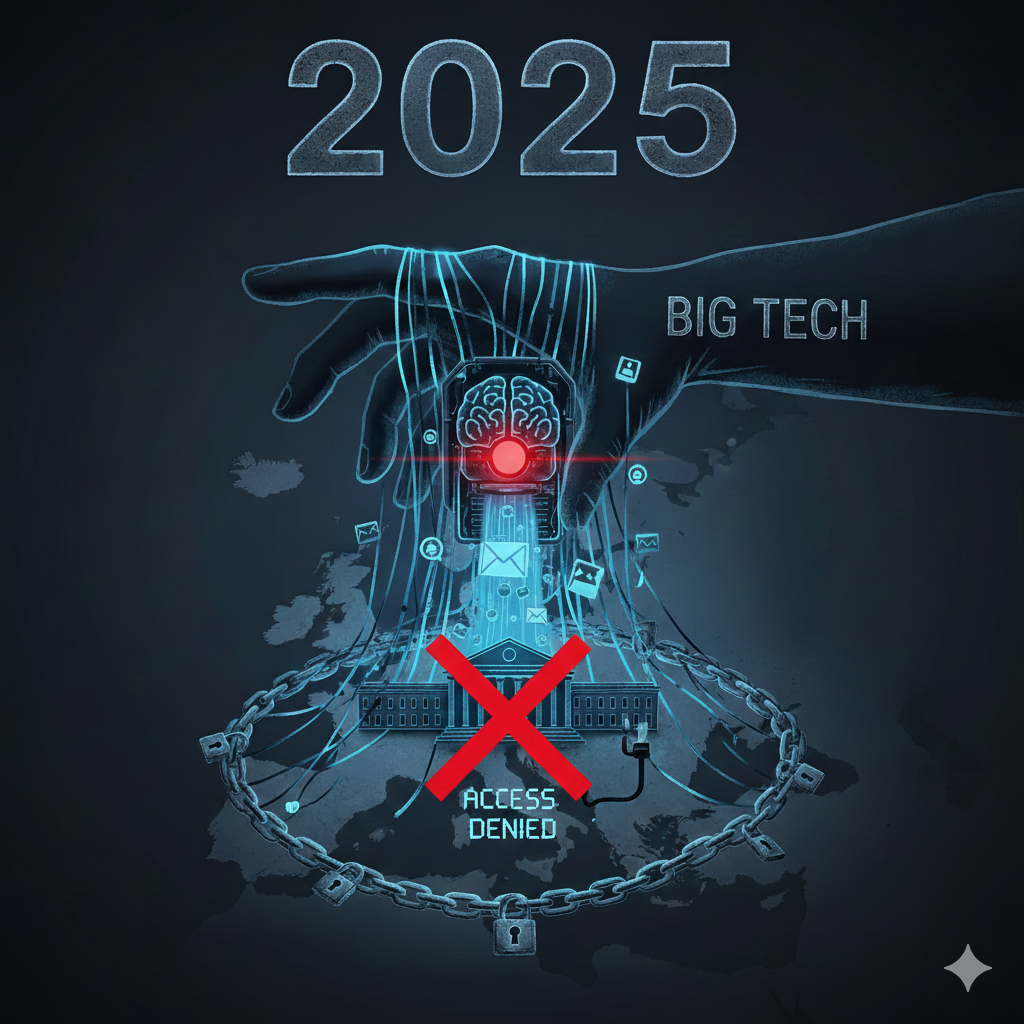
Experts warned earlier: “Europe is digitally dependent on the US-everything can be shut down with a single click.” Back then it sounded like a far‑fetched doomsday scenario. How could an ally do that?
But on May 16, 2025, we saw what that ‘button’ looks like in practice. Microsoft blocked the email accounts of the Chief Prosecutor of the International Criminal Court (ICC) in The Hague. Due to political pressure from the US, an independent legal institution was digitally gagged. Case files became inaccessible. Communication went dark.
This incident proves something fundamental: our vital infrastructure is a guest on servers we don’t control. If a tech giant (or the government behind it) decides you’re a problem, you’re out-whether you’re a citizen or an international court.
Your life as training data (unless you opt out)
While our sovereignty is at stake, our private lives are being eroded too. Remember the call? “Object now if you don’t want Meta training AI on your data.”
It’s a complete reversal. Instead of companies asking permission to use your vacation photos, children’s videos, and private messages to make their AI models smarter (and more profitable), they just take it-unless you fight through confusing menus to say “no.” In 2025, it became clear that Big Tech doesn’t see your data as your property, but as free raw material. Amnesty International warned about this as early as August: this business model is a fundamental threat to human rights.
Why Big Tech isn’t a safe harbor
This year’s conclusion is hard but clear. We’re facing three structural problems we can’t ignore any longer:
- The Kill Switch: As NU.nl described and the ICC experienced, services can be shut off unilaterally.
- Data exploitation: As NOS and AP warned, your memories are used to train commercial AI.
- Abuse of power: As Amnesty states, concentrating power in a handful of companies endangers our freedom.
The solution is in Europe: PixelUnion
We don’t have to accept this. The only way to break Big Tech’s power is to bring our data back home-to Europe.
At PixelUnion.eu, we do things differently. We believe your photos belong to you-and to nobody else.
- No AI training: We don’t look into your files. Your memories aren’t fuel for an algorithm.
- European protection: Your data lives on servers in Europe, protected by European law. No US “Cloud Act” access.
- Transparent: No fine print or hidden opt‑out menus. You’re the customer, not the product.
Take back control today
Don’t wait for the next scandal, the next block, or the next terms-of-service change. 2025 was the wake-up call we needed.
Step out of Big Tech’s shadow. Choose privacy, security, and sovereignty.
👉 Move your photos to PixelUnion today.